

How Much Stock to Order for the Holiday Rush: Simple Order-Depth Math for Beauty Supply Stores
Every beauty supply owner knows the January regret of a holiday overbuy. But talk to enough store owners and you'll hear the opposite story more often: the fragrance wall that sold bare by December 18, the display that could have sold twice over if the stock had been there. A markdown in January costs you margin. An empty shelf in December costs you the sale, the basket around it, and sometimes the customer.
 November and December bring the heaviest foot traffic of the year, and the orders that carry you through it get placed now. Stock ordered this week ships within 3 business days, which means it's received, priced, and on the shelf by mid-October, with time to spare before November traffic. So here's how to size those orders without software: three numbers, multiplied.
Order depth = baseline weekly rate × peak multiplier × weeks of cover
Step 1: Find your baseline weekly rate
For each product you're sizing, count what you actually sold over the last four normal weeks and divide by four. Your POS report does this in a minute; so does counting what you've reordered since Labor Day. Resist the urge to use your gut. Gut numbers run high on products you like and low on the quiet workhorses that pay the rent.
Do this only for the products that matter: your top 20–30 sellers cover most of your holiday revenue. Everything else gets handled in Step 4.
Step 2: Set your peak multiplier from your own November
How much busier is your holiday season than a normal month? Your own register history is the only honest answer. Pull last November and December's sales for the same products (or just total store sales) and divide by an average month. That ratio (maybe 1.5×, maybe 2×, maybe 3× on gift items) is your peak multiplier, and it's different for every store and every category. Gift-friendly products spike harder than everyday replenishment items: fragrance jumps more than shampoo.
First holiday season, or no records? Start at a conservative 1.5× and lean on the wave calendar below. With fast restocks available, you don't have to guess right the first time.
Step 3: Choose your weeks of cover
Weeks of cover is how long this order needs to last before the next one arrives. If you plan to reorder in early November (and you should; see the calendar), your October order needs roughly 3–4 weeks of cover. A longer gap means more cover, more cash tied up, and more risk. Shorter gaps are the whole advantage of a supplier that ships fast with no minimums: you can afford to order less, more often.
The math in action
Say your store sells 12 bottles a week of a proven fragrance roll-on scent in a normal week. Your register says last holiday season ran about twice as hot as a normal month. You're ordering now and plan a second order in early November, so call it 3 weeks of cover.
12 per week × 2 peak × 3 weeks = 72 bottles.
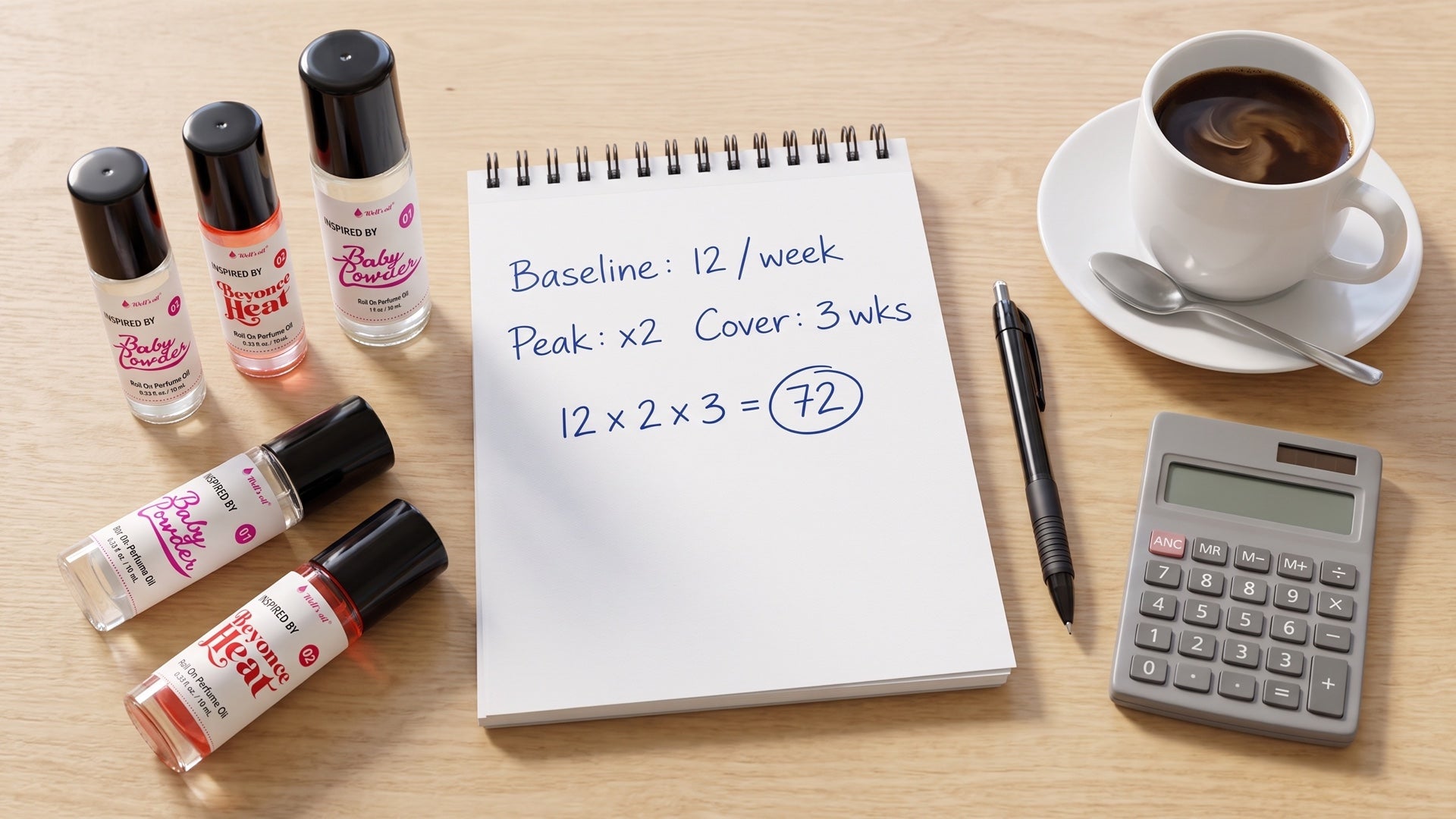
That number usually feels high. That's the point: the formula exists to override the instinct that under-orders proven sellers. Notice what it's protecting: not an experiment, but a product your own register already voted for.
Step 4: Where to go deep, and where to trial shallow
Run the full formula on products with a track record, and go deepest where gifting demand stacks on top of it:
- Your proven sellers. For most stores that starts with the fragrance category. Perfume body oil roll-ons are our #1 seller for a reason, and the 1 fl. oz. size gives the same wall a giftable step-up.
- Gift price points. Items that work as a grab-and-go gift or stocking stuffer earn extra depth November through December.
- Counter and impulse zones. The spots you reset for the season (per our checkout counter merchandising guide) turn over faster than their shelf positions suggest.
Trial shallow everywhere else. A category you've never carried gets a toe in the water, not a cannonball, and with no minimum order quantity, a trial can be literally a handful of units. For a brand-new category, a ready-made display set like the Perfume Body Oil Roll-On Display Set or the 120-Kinds Roll-On + Fragrance Oil Display Stand is the one exception where depth and trial come in the same box: full assortment, fixture included, one SKU to reorder.
Order in waves, not one bet
The formula sizes each order. The calendar is what de-risks the season: three smaller bets instead of one big one.
- Wave 1 (this week, early October): Depth on proven sellers and gift items, sized by the formula. On your shelf by mid-October, displayed before November traffic.
- Wave 2 (early November): Reorder what Wave 1 is proving out, fill the gaps, and top up before the Thanksgiving–Black Friday weekend (Nov. 26–27). By now your own register has replaced every guess in the formula with a fact.
- Wave 3 (early December): Chase orders on whatever December is selling. With orders shipping within 3 business days, an early-December reorder still has time to land before the final gift rush. This is the wave that saves the bestseller wall on December 18.

Waves work because restocking is easy with IWELL US Wholesale: we offer no minimum order quantity, so a chase order can be exactly what you need, plus free shipping on orders over $500 (a flat $35 below). Each wave sized by the formula clears that threshold comfortably. Questions about ordering? See our ordering FAQ.
Ten minutes, three numbers, three waves. That's holiday inventory planning, no software required.